

Bordeaux
Bordeaux: Elegance, Wine and Joie de Vivre on the Garonne
Bordeaux is one of France’s most striking cities — without ever trying too hard to impress at first glance. What makes this city on the Garonne special reveals itself as you wander: golden 18th-century limestone façades, elegant avenues, lively squares and a culture of pleasure deeply woven into the wines of the region. Listed as a UNESCO World Heritage Site under the name “Port de la Lune,” the old town is one of Europe’s best-preserved urban ensembles — an essential stop for anyone visiting the French Atlantic coast.
Place de la Bourse and the Miroir d’eau: The City’s Icon
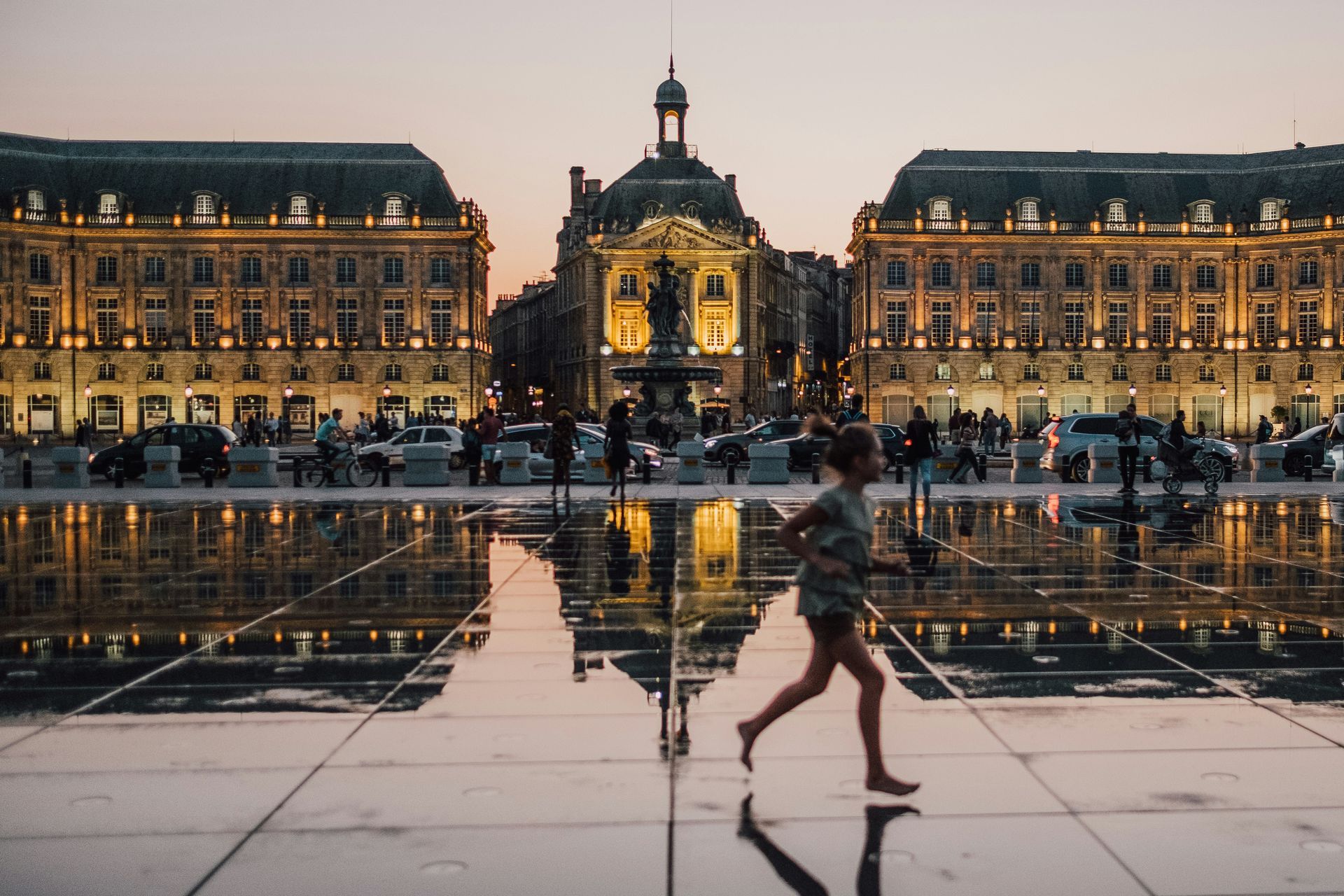
No image captures Bordeaux quite like the view of Place de la Bourse reflected in the “Miroir d’eau” opposite. The world’s largest reflecting pool transforms, depending on the weather, into a perfectly still mirror or a fine mist, through which children and adults alike love to walk barefoot. Especially in the evening, when the façades of Place de la Bourse glow golden in the light, this spot becomes one of the city’s most atmospheric sights.
Cité du Vin: Wine as an Experience
An architectural highlight right on the riverbank, the Cité du Vin is a cultural centre entirely devoted to the history, culture and diversity of wine around the world. The building’s sweeping, modern façade catches the eye from a distance, and its top-floor viewing platform offers sweeping views over the city and river — best enjoyed with a glass of wine in hand. A perfect starting point for anyone planning to head on to the Médoc or Saint-Émilion afterwards.
Historic Old Town and Elegant Architecture
Bordeaux’s historic centre, defined by its 18th-century neoclassical limestone façades, was named a UNESCO World Heritage Site under the title “Port de la Lune” — the largest urban ensemble of its kind in France. Rue Sainte-Catherine, one of the longest pedestrian shopping streets in Europe, links the city’s central squares and neighbourhoods. The Grand Théâtre, with its striking colonnaded façade, ranks among the finest opera houses in Europe, while the Saint-Pierre district, with its narrow lanes and small restaurants, is made for wandering.
The Neighbourhoods: Chartrons and Saint-Michel
The Chartrons district, once the centre of the city’s wine trade, has become one of Bordeaux’s most sought-after neighbourhoods: antique shops, independent boutiques, wine bars and cafés line its quiet, tree-shaded streets. The atmosphere is entirely different in Saint-Michel, around the Gothic basilica: this is where the city’s multicultural heartbeat lives on, with a lively flea market and a colourful mix of cultures.
Local Flavour: Wine, Canelés and Bordelais Cuisine
No visit to Bordeaux is complete without some culinary exploration. The small, caramelised canelés — crisp on the outside, soft within — are the city’s sweet emblem, while the classic “entrecôte à la bordelaise,” topped with a rich red wine sauce, appears on nearly every menu. In the city’s many wine bars, you can taste wines from the Médoc, Saint-Émilion and Graves without ever leaving the centre — an ideal warm-up for trips into the surrounding wine country.